


Angeles Crest often makes headlines. Whether it’s idiots flying off cliffs, rogue influencers driving recklessly for internet clout, or horrifying crashes, it is an unfortunate hotspot for well-publicized incidents. As a local, I’ve always wondered: Just how bad is the situation on Crest? Well, someone made a map of nearly every incident on Crest in the last 10 years.
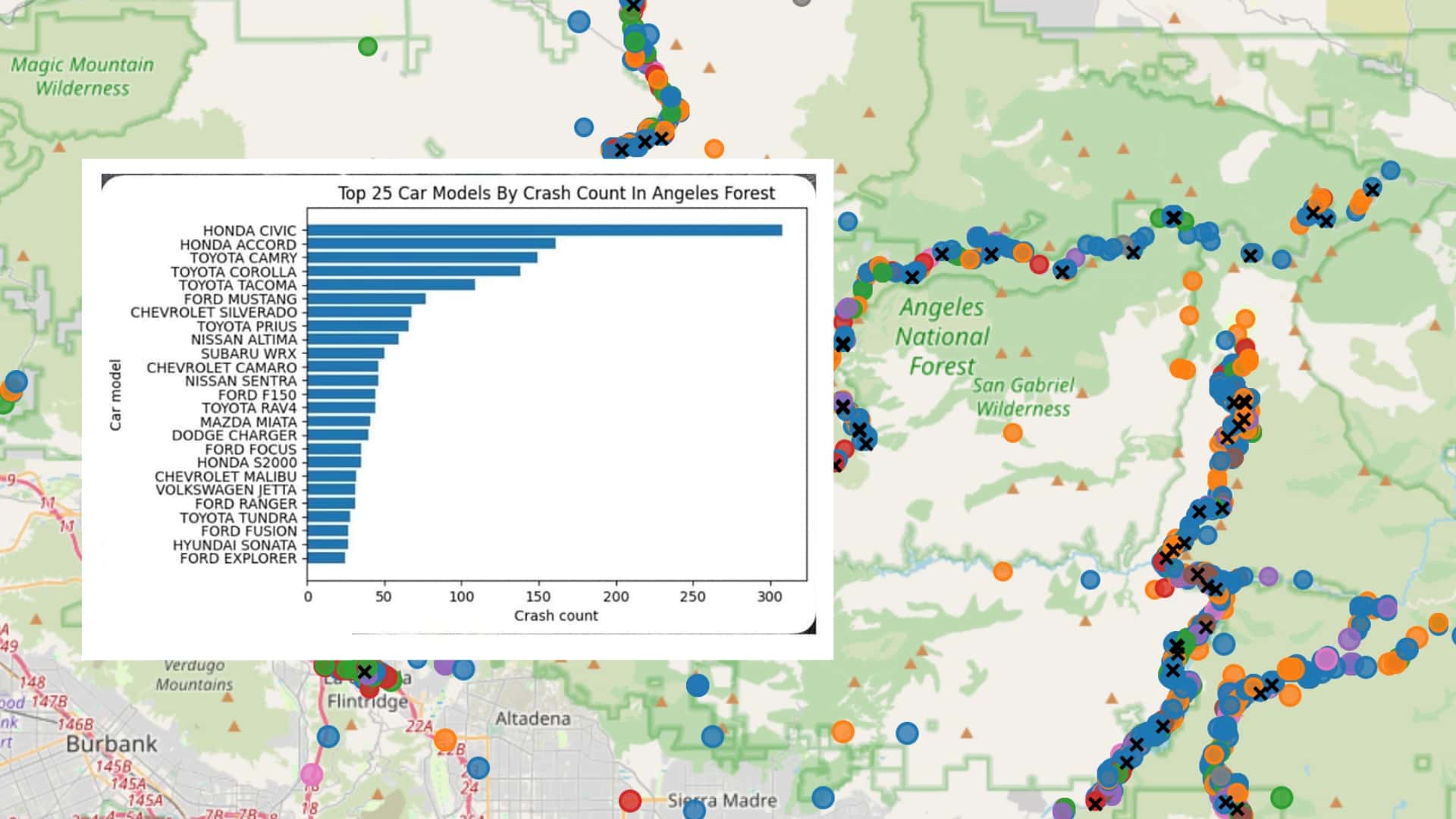
Thanks to Instagram user @bluturt, who compiled data from the California Highway Patrol, we can see a heat map of crashes broken down by crash type. Each data point also includes the original report, which describes the incident and the vehicles involved.
He does say that the “CHP data is pretty dirty,” which means the map isn’t definitive by any stretch. But it is an interesting reference point, especially to someone like me who drives the road three to four days a week.
What Does The Data Say?
At first glance, the data looks dire. Nearly every inch of the road is covered in crashes, with a good amount of fatal crashes to boot (which are marked on the map with an “x”). But there are a few interesting things to point out amid the wreckage.
The most crashed vehicle in the forest is a Honda Civic; maybe not all that surprising. Most crashes occur during the morning and afternoon commuter rush hours. And motorcycle crashes happen mostly on Sundays.

Photo by: Bluturt
For context, Angeles Crest Highway (ACH) is just the main road that runs through the Angeles National Forest. There are several companion roads: Angeles Forest Highway (AFH), Big Tujunga Canyon Road, and Upper Big Tujunga Canyon Road (known to locals as Nine Mile). All of which are included in this map.
ACH runs from La Cañada Flintridge to the mountain town of Wrightwood, effectively serving as a sightseeing and recreational road. AFH connects ACH to Palmdale, serving as a critical commuter road. Big Tujunga and Upper Big Tujunga connect the valley city of Sunland to AFH, then to Wrightwood. The most important one to note is AFH, because it heavily influences the dataset presented here.
The Commuter Effect
Photo by: Chris Rosales / Motor1
As far back as the 90s, AFH was known as the home of the “Palmdale 500.” Every day, from 5 AM to 9 AM, then again from about 3 PM to 7 PM, thousands of commuters used the road to get to Los Angeles as an alternative to State Route 14, which is often congested.
In this 1992 LA Times article, many of the same problems that exist today were evident. People passing around blind turns, going too fast for the conditions, and generally rushing to get home. I know it because I am a regular Palmdale commuter and drive the road at least 4 times per week. It’s a warzone, to say the least.
I also drive ACH recreationally at about the same frequency. While the overall dataset is skewed toward commuters, there is no doubt that enthusiasts like myself contribute to the issue. In fact, the breakdown of car crashes per day of the week shows that weekends are just as incident-prone as weekdays. While there are still commuters on the weekend, it’s nowhere near as many as on weekdays.
Where Enthusiasts Contribute
Where AFH, the commuter road, is covered in incidents, ACH has more defined hotspots and problem corners. For example, the corner where Call of Duty creator Vince Zampella tragically crashed his Ferrari shows a strong cluster of single-vehicle-hit-object crashes. Another corner, close to a place called Windy Gap and affectionately referred to as “the shadies,” is a well-known danger area amongst locals, showing a concentration of rollovers.
Nearly every turn that locals know to be a problem area is covered in incidents, which you can see below.
The truth of the matter is this: ACH does have a strong community of spirited drivers. That ranges from people who drive at a fun pace to people who drive pretty hard. There is no reason, as an enthusiast, to crash on a road like Crest… besides hitting a deer, or the four people that hit a bear.
Several factors likely contribute to ACH’s high density of crashes—its close proximity to the Southland, immense popularity amongst enthusiasts, or a really shitty commute–but commuters and drivers alike could do with a bit more respect towards the road. It can and will bite back.
Enjoy the map, and let us know what interesting details you find.
Source link